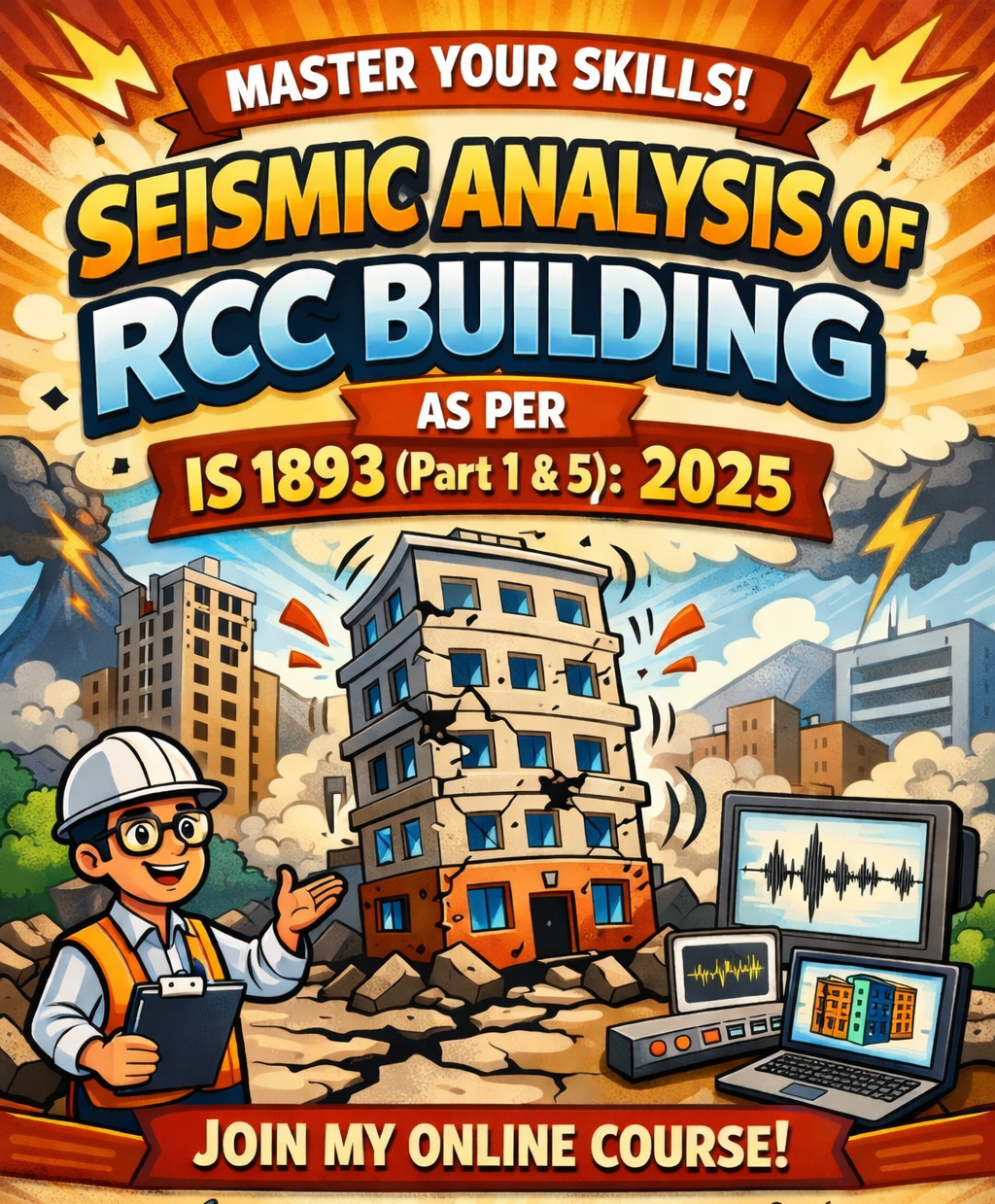
What will be discussed in the course?
- Basic understanding of Elastic Rebound Theory
- Continental Drift Theory by Alfred Wegener
- Plate Tectonics
- Types of faults
- Coverging, Diverging, Transform boundaries
- Basics of Hazard and Risk Analysis
- Basics of Deterministic Seismic Hazard Analysis
- Basic Inputs for GMPE and limitations with DSHA
- Understanding DSHA Vs PSHA- Basics
- Understanding Return Periods
- Understanding the approach of IS 1893 (Part 1) : 2025
- Understanding the clauses of IS 1893 (Part 5) : 2025 for building analysis
- Zone factors and Important factors- what is different from 2016 version of code
- Maximum Credible/Considered Earthquake
- Classification of buildings
- Site classification
- Estimation of design horizontal acceleration coefficient
- Comparison of AHD with 2016 version of code
- Estimation of design vertical acceleration coefficient
- Static Analsis of Building in current versions of ETABS as per 2025 version of code
- Static Analsis of Building in current versions of STAAD. Pro as per 2025 version of code
- Development of Response Spectrum as per new code for software input
- Response Spectrum Analysis in ETABS as per 2025 version of code in current versions of ETABS/STAAD. Pro
- Plan and vertical irregularities
- Understanding torsional flexibility and estimating torsional flexibility factor
- Design eccentricity
- Structural systems
- Understanding seismic analysis and demand requirements of Architectural Elements and Utilities (AEUs)
- Design load combinations
- Seismic Analysis of Building with podium
- Undestanding the response of recomended structural configurations for Buildings on hill slopes
- Estimation of approximate fundamental natural time period of the building as per new code and comparison with the 2016 version of code.
- Understanding the overstrength factors
- Estimation of equivalent width for URM
- Modelling of URM in ETABS and analsys fundamentals
- Additional criteria for concrete buildings
- Response History Analysis in ETABS
- Drift check and Drift limits
- Effective sections properties
- Elastic Force Reduction factors
- Elastic and inelastic deformation
- Diaphragm and types
- Performace and damange objectives
- Key elements
- Cantilever projections
MODE OF COURSE:
Online Pre-recorded courses (to be taken as self paced)
Validity: Till Ilustraca Academy platform exists